



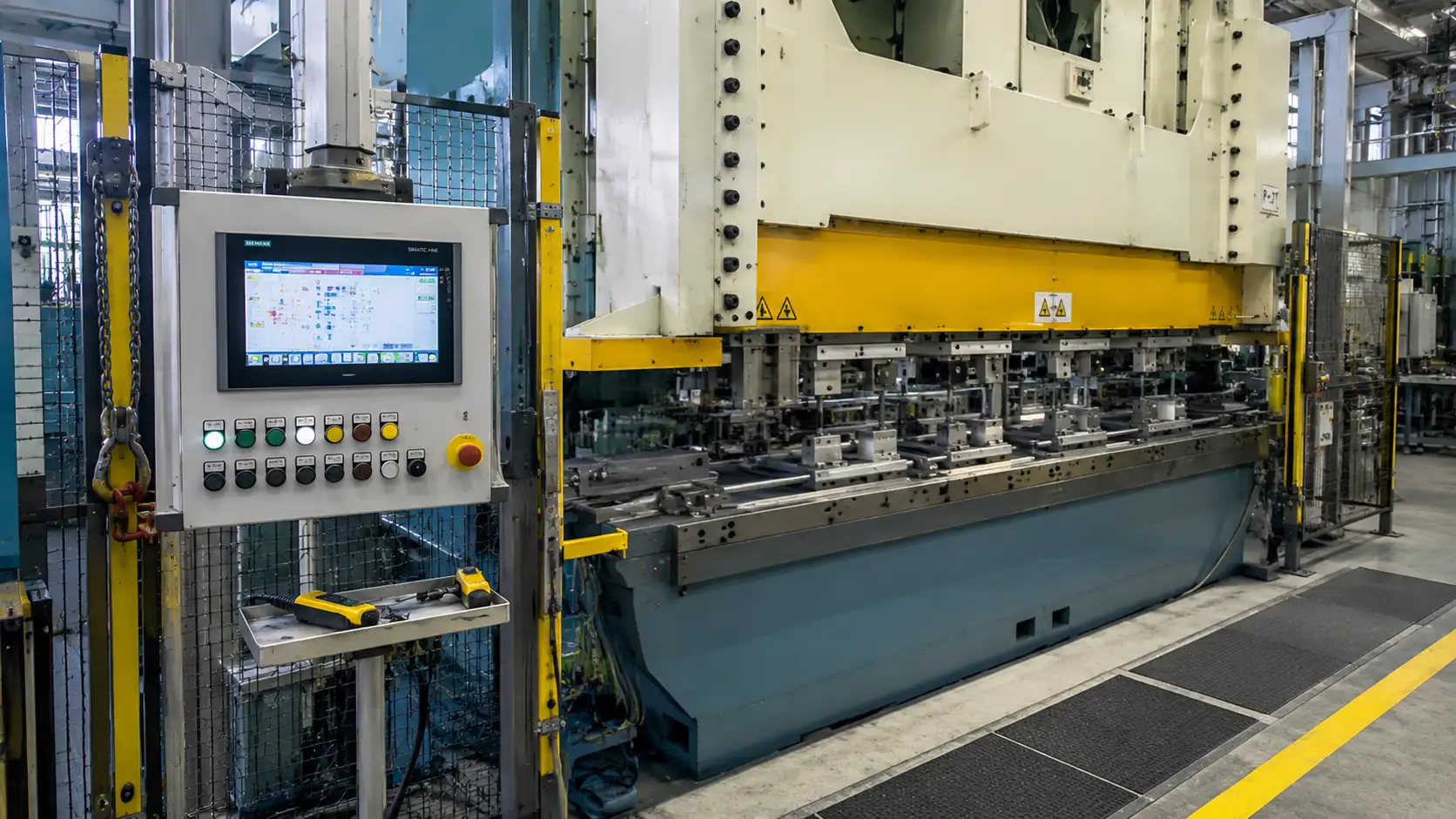
Older press lines remain an important part of production for many manufacturing companies. While the press itself is often in good condition, aging control systems, worn feeding equipment, and limited availability of spare parts can create issues that affect both production capacity and profitability.
When downtime becomes more frequent, it is easy to assume that investing in a completely new production line is the only solution. In reality, modernizing an existing press line can often deliver significant improvements at a much lower cost. By upgrading control systems, feeding equipment, coil handling, and safety features, it is often possible to extend the service life of the line by 10–15 years while improving operational reliability.
In this guide, we explore seven common problems found in older press lines and the solutions that deliver the best results.
1. Unplanned Downtime Reduces Productivity
One of the most common problems with older press lines is increasingly frequent unplanned downtime. This is often caused by wear in critical components or electronic systems that are approaching the end of their service life.
Common Symptoms
- Production stoppages with no obvious cause
- Recurring alarms
- Intermittent faults
- Extended downtime during maintenance
Consequences
Every production stoppage affects delivery reliability and can quickly become costly. In many cases, the resulting production losses are far more expensive than the repair itself.
Solution
Regular inspections and preventive maintenance make it possible to identify wear before it leads to failures. Inspect critical components and assess their condition to detect potential issues at an early stage.
2. Outdated Control Systems Create Unnecessary Risks
Many older press lines use PLC systems and operator panels that are no longer supported by the manufacturer. When a component fails, replacement parts can be difficult to source.
Common Symptoms
- Slow Troubleshooting
- Limited Functionality
- Difficulties Integrating New Equipment
- High Vulnerability to Component Failures
Real-World Experience
At One Automation, we often encounter production lines where the mechanical design is still performing exceptionally well, while the control system has become the greatest source of risk. A single faulty circuit board or failed operator panel can result in prolonged production downtime.
Solution
A control system upgrade for press lines improves both monitoring and operational reliability. Modern systems make it easier to optimize production, adjust process parameters, and analyze data from the production line.
3. Pneumatic Issues Cause Inconsistent Operation
Pneumatic issues are common in older production equipment. Air leaks, worn seals, or faulty valves can affect both the feeding system and material flow.
Common Symptoms
- Inconsistent Material Feeding
- Inconsistent Positioning
- Gripper Problems
- Need for Manual Adjustments
Consequences
When air pressure fluctuates, production becomes less stable. This can lead to quality issues and increased scrap rates.
Solution
Regularly inspect air pressure, valves, and hoses. Clean filters, check all connections, and replace worn seals when necessary. This helps restore stable and reliable operation. Always begin by identifying the source of the problem. During troubleshooting, it is important to isolate the fault to a specific part of the system before replacing any components.
4. Mechanical Wear Leads to Damage
After many years of operation, bearings, shafts, and other moving components are subjected to significant stress. Over time, wear can lead to damage, cracks, and deformation.
Common Symptoms
- Unusual Vibrations
- Increased Noise
- Irregular Operation
- Visible Cracks
Consequences
Damaged components can cause extensive downtime if they are not detected in time. In the worst case, a minor issue can develop into a costly equipment failure.
Solution
Regular inspections make it possible to detect mechanical issues at an early stage. If a component is damaged, it should be repaired or replaced before the problem spreads to other parts of the production line. The earlier an issue is identified, the easier and less costly it is to resolve before it leads to major production downtime.
5. Misaligned Systems Reduce Precision
When straightening machines, roll feeders, or other feeding equipment are not properly aligned, the entire production process is affected.
Common Symptoms
- Inconsistent Material Feeding
- Dimensional Deviations
- Reduced Precision
- Increased Scrap Rates
Consequences
Even small misalignments can introduce stress into the material, resulting in inconsistent product quality.
Solution
Regularly verify that the equipment is properly aligned. In many cases, simply adjusting the feeding equipment is enough to improve precision and reduce wear on tools and machine components. Stable, consistent material feeding is often essential for achieving high precision and minimizing the risk of quality deviations.
6. When Repairs Become More Expensive Than Modernization
When maintenance requirements continue to increase year after year, it is often a sign that the production line needs to be upgraded.
Common Symptoms
- Frequent repairs
- Rising spare parts costs
- Increased troubleshooting time
- Recurring faults
Consequences
It is easy to focus on the cost of an individual repair. In reality, the greatest expense often comes from reduced equipment availability and lower production efficiency.
Solution
Regular cleaning, the use of the correct lubricants, and routine hydraulic system inspections help reduce wear. If maintenance costs continue to rise, it may be time to evaluate whether modernization is a more cost-effective solution.
7. Limited Capacity Restricts Future Growth
Older press lines were designed for production requirements that differ from today's demands. As a result, their production capacity may no longer be sufficient.
Common Symptoms
- Long changeover times
- Limited automation
- Bottlenecks in material handling
- Difficulty meeting increased production demands
Solution
By upgrading control systems, feeding equipment, and automation solutions, it is often possible to increase production capacity without investing in an entirely new production line.
Modernization or a New Investment – Which Delivers the Best Return?
It is easy to assume that a new press line is always the best solution. In practice, however, significant improvements can often be achieved through targeted upgrades. If the mechanical structure is still in good condition, modernization can be a far more cost-effective alternative than replacing the entire production line.
If the mechanical structure is still in good condition, upgrading the control system, coil handling, feeding equipment, and machine safety can deliver significant productivity gains. At the same time, operational reliability is improved and spare parts become more readily available.
For many companies, a technical assessment is the best way to determine which investments will deliver the highest return.
Summary
Common problems in older press lines often include mechanical wear, outdated control systems, pneumatic issues, and recurring downtime. Through preventive maintenance, regular inspections, and strategic upgrades, it is possible to improve both operational reliability and productivity.
In many cases, modernizing a press line can deliver many of the same benefits as a much larger investment in new equipment. By upgrading the right components at the right time, companies can ensure stable, reliable production for many years to come.
Frequently Asked Questions About Older Press Lines
When Is It Worth Modernizing a Press Line?
If downtime becomes more frequent, maintenance costs continue to rise, or spare parts become difficult to obtain, it is often the right time to evaluate a modernization.
How Much Does It Cost to Modernize a Press Line Compared to Buying a New One?
The cost depends on the condition of the production line and the scope of the upgrade. In many cases, modernization is significantly more cost-effective than investing in an entirely new press line.
Which Components Are Most Commonly Modernized?
Common upgrades include control systems, feeding equipment, coil handling, pneumatic systems, hydraulic systems, and machine safety.
How Long Can a Modernized Press Line Remain in Service?
A well-executed modernization can often extend the service life of a press line by 10–15 years or more.
How Does Modernization Affect Productivity?
By reducing downtime, improving precision, and increasing the level of automation, modernization can significantly enhance both production capacity and operational reliability.




 English
  Svenska